
Showing posts with label House. Show all posts

Sunday, September 18, 2011

WHAT MAKES PORCELAIN TOWER OF NANJING AMAZING?

            Do you have an idea about the Porcelain Tower of Nanjing? If no, this short review of mine can help you or can give you an idea about this tower.

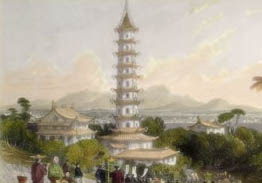
Here is the picture of the tower:

PORCELAIN TOWER OF NANJING


      Amazing isn't it? That is the Porcelain Tower of Nanjing. One of the Seven Medieval Wonders of the World. 

      This is my short briefing about the Porcelain Tower of Nanjing. The Porcelain Tower or Porcelain Pagoda of Nanjing, also known as Bao'ensi  which means "Temple of Gratitude", is a historical site located on the south bank of the Yangtze in Nanjing, China. It was a pagoda constructed in the 15th century during the Ming Dynasty, but was mostly destroyed in the 19th century during the course of the Taiping Rebellion. In 2010 Wang Jianlin, a Chinese businessman, donated one billion yuan to the city of Nanjing for its reconstruction. This is reported to be the largest single personal donation ever made in China. And one of the famous monument in China.

     Another information is that, It was built in the early 15th century, the Porcelain Tower of Nanjing was designed by Emperor Yongle of China as a Buddhist pagoda, and was often listed by westerners as one of the Seven Wonders of the World. The 260 foot tower was one of the largest buildings in China, and got it's name from the white porecelain bricks it was built with. It was destroyed during the Taiping Rebellion. We're not quite sure yet why it is one of the Korean wonders, considering it's location in China. The brilliant white porcelain bricks that faced the tower were what made it so unforgettable. By day, the bricks glittered in the sun, and at night they were illuminated by perhaps as many as 140 lamps hanging around the exterior of the pagoda. Worked into the porcelain panels were colorful stoneware tiles with green, yellow, white, and brown glazes forming images of animals, landscapes, flowers, and bamboo. That is why the people in China were so proud.


   However, Nanjing, or "the southern capital," is the name by which Keang-ning, chief city in the province of Keang-soo, in China, has been popularly known for several centuries. The present city, which stands in 32° 5´ N. lat. and 118° 47´ E. long., dates only from the beginning of the Ming dynasty (1368), although it is built on the site of one which for more than two thousand years has figured under various names in the history of the empire. The more ancient city was originally known as King-ling ; under the Han dynasty (206 B.C. to 25 A.D.) its name was converted into Tan-yang ; by the T’ang emperors (618-907 A.D.) it was styled Keang-nan and Shing Chow ; by the first sovereign of the Ming dynasty (1368-1644 A.D.) it was created the "southern capital" (Nan-king), and was given the distinctive name of Ying-t’een ; and since the accession to power of the present Manchu rulers it has been officially known as Keang-ning, though still popularly called Nan-King. As a matter of fact it was the seat of the imperial court only during the reigns of the first two emperors of the Ming dynasty, and was deserted for Shunt’een (Peking) by Yung-lo, the third sovereign of that line, who in 1403 captured the town and usurped the crown of his nephew, the reigning emperor. From an octagonal base about 97 feet in diameter, the tower's nine stories rose pyramidally to a height of about 260 feet. According to information obtained by an American missionary who journeyed to Nanjing in 1852, the original plan for the tower had called for 13 stories and a total height of about 330 feet. Although those ambitious dimensions were never realized, the smaller size made little difference, because size was not what made the structure so memorable for visitors.
The tower was octagonal with a base of about 97 feet (30 m) in diameter. When it was built, the tower was one of the largest buildings in China, rising up to a height of 260 feet (79 m) with nine stories and a staircase in the middle of the pagoda, which spiraled upwards for 184 steps. The top of the roof was marked by a golden pineapple. There were original plans to add more stories, according to an American missionary who in 1852 visited Nanjing. There are only a few Chinese pagodas that surpass its height, such as the still existent 275-foot-tall (84 m) 11th-century Liaodi Pagoda in Hebei or the no longer existent 330-foot-tall (100 m) 7th-century wooden pagoda of Chang'an.
The tower was built with white porcelain bricks that were said to reflect the sun's rays during the day, and at night as many as 140 lamps were hung from the building to illuminate the tower. Glazes and stoneware were worked into the porcelain and created a mixture of green, yellow, brown and white designs on the sides of the tower, including animals, flowers and landscapes. The tower was also decorated with numerous Buddhist images because of their beliefs in Buddha.


WHAT IS THE PURPOSE OF THE GREAT WALL OF CHINA?


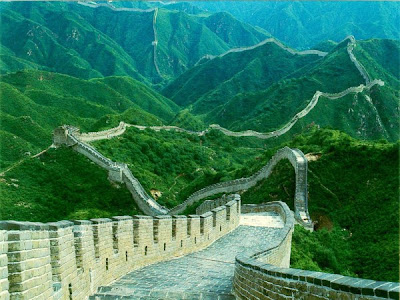
            Wow!!!! It is really amazing to see a man made like this. The Great Wall of China is one of the famous monument in the world that  is why it was chosen as one of the Seven Medieval Wonders of the World. 

             In my research about the Great wall of China, I discovered that the Great Wall of China is a series of stone and earthen fortifications in northern China, built originally to protect the northern borders of the Chinese Empire against intrusions by various nomadic groups. Several walls have been built since the 5th century BC that are referred to collectively as the Great Wall, which has been rebuilt and maintained from the 5th century BC through the 16th century. One of the most famous is the wall built between 220–206 BC by the first Emperor of China, Qin Shi Huang. Little of that wall remains; the majority of the existing wall was built during the Ming Dynasty. And now still existing the world. 


      A no ending wall, which can protect them from the enemy. The Great Wall of China, one of the greatest wonders of the world, was listed as a World Heritage by UNESCO in 1987. Just like a gigantic dragon, the Great Wall winds up and down across deserts, grasslands, mountains and plateaus, stretching approximately 8,851.8 kilometers (5,500 miles) from east to west of China. With a history of more than 2000 years, some of the sections are now in ruins or have disappeared. However, it is still one of the most appealing attractions all around the world owing to its architectural grandeur and historical significance. The Great Wall stretches from Shanhaiguan in the east, to Lop Lake in the west, along an arc that roughly delineates the southern edge of Inner Mongolia. The most comprehensive archaeological survey, using advanced technologies, has concluded that the entire Great Wall, with all of its branches, stretches for 8,851.8 km (5,500.3 mi). This is made up of 6,259.6 km (3,889.5 mi) sections of actual wall, 359.7 km (223.5 mi) of trenches and 2,232.5 km (1,387.2 mi) of natural defensive barriers such as hills and rivers. See the picture at the right side to witness the Great Wall of China.


         In a long run of my research, I found out that The Great Wall of China was built to protect China. Called as the giant dragon that goes on and on endlessly along the plains, mountains, countryside was once around 4000 miles long but now due to modernization and misuse is only 1500 miles long. The rest have all fallen apart and disappeared. This man-made wall was built of stones and dirt and it falls under the 100 most endangered sites by the World Monuments Fund. The first Emperor of China Qin Shi Huangdi built the Great Wall of China. It took 10 years to build the Great wall of China. The Great Wall is in grave danger of extinction as nature and man both are taking their toll on it. The Great Wall of China was built over 2,000 years ago, by Qin Shi Huangdi, the first emperor of China during the Qin (Ch’in) Dynasty (221 B.C – 206 B.C.). In Chinese the wall is called “Wan-Li Qang-Qeng” which means 10,000-Li Long Wall (10,000 Li = about 5,000 km). After subjugating and uniting China from seven Warring States, the emperor connected and extended four old fortification walls along the north of China that originated about 700 B.C. (over 2500 years ago). Armies were stationed along the wall as a first line of defense against the invading nomadic Hsiung Nu tribes north of China (the Huns). Signal fires from the Wall provided early warning of an attack. And make them ready for the battle.         

     It is also one of the favorite place of the travelers or guests or tourists. See the picture at my left side as a proof. Having a wonderful Great Wall tour is a must for your China Trip. Want to discover the charm of the wall with Travel China Guide? Please see our Memorable Highlights Tours. Practical Great Wall travel tips are offered including the best travel time, packing list as well as health and safety concerns to make you safe when you wanted to visit this place.


WHAT ARE THE MISIRIES OF THE CATACOMBS OF KOM EL SHOQAFA?

        Don't you know that the meaning of Catacombs of Kom El Shoqafa is 'Mound of shards' or 'Potsherds' ? And don't you know that it is one of the seven Medieval Wonders of the World? Well, if not then read carefully my review about the Catacombs of Kom El Shoqafa.

        While reading my review, maybe there is a question in your mind like where can we find the Catacombs of Kom El Shoqafa? or Why is it the Catacombs of Kom El Shoqafa belongs to the seven Medieval wonders of the World and etc. I hope that this short review of mine can answer those questions on your mind.

         Now, what is the Catacombs of Kom El Shoqafa? The Catacombs of Kom El Shoqafa means " Mound of shards" or Potsherds". It is a historical archaeological site located in Alexandria, Egypt and is considered one of the Seven Wonders of the Middle Ages. The necropolis consists of a series of Alexandrian tombs, statues and archaeological objects of the Pharaonic funeral cult with Hellenistic and early Imperial Roman influences. Due to the time period, many of the features of the Catacombs of Kom el Shoqafa merge Roman, Greek and Egyptian cultural points; some statues are Egyptian in style, yet bear Roman clothes and hair style whilst other features share a similar style. A circular staircase, which was often used to transport deceased bodies down the middle of it, leads down into the tombs that were tunneled into the bedrock during the age of the Antonine emperors (2nd century AD). The facility was then used as a burial chamber from the 2nd century to the 4th century, before being rediscovered in 1900 when a donkey accidentally fell into the access shaft. To date, three sarcophagi have been found, along with other human and animal remains which were added later. It is believed that the catacombs were only intended for a single family, but it is unclear why the site was expanded in order to house numerous other individuals. The Catacombs of Kom el Shoqafa is, according to some lists, also one of the seven medieval wonders of the world. One of the more gruesome features of the catacombs is the so called Hall of Caracalla. According to tradition, this is a mass burial chamber for the humans and animals massacred by order of the Emperor Caracalla. Meaning, It is very important or it is very meaningful or memorable for the people of that place.


         In other words, the Catacombs of Kom el Shoqafa, is the Arab translation of the ancient Greek name, Lofus Kiramaikos which means “mound of shards” or “potsherds”. Located to the southwest of the Pompey’s pillar is a multi level labyrinth featuring dozens of chambers adorned with sculpted pillars, statues and other Romano Egyptian religious symbols, burial niches and sarcophagi as well as a banquet room of Roman style, where memorial meals were conducted by relatives of the deceased. The most memorable place of the Romano Egyptians.


            In addition of my review, the catacomb of Kom El-Shuqafa (Shoqafa, Shaqafa) is one of Alexandria's most memorable monuments.  Identified as "a tour-de-force of rock-cut architecture which would be remarkable in any period," the Great Catacomb defies comprehensible description.Its vast, intricately decorated interior spaces cut at so great a depth into the rock present an enormity of experience outside the normal human realm and tell us of a level of technological expertise equaling enterprises of modern subways and tunnels while far surpassing them in aesthetic response. Kom El-Shuqafa is the Arab translation of the ancient Greek name, Lofus Kiramaikos, meaning "Mound of Shards" or "Potsherds." Its actual ancient Egyptian name was Ra-Qedil. The catacombs are unique both for their plan and for its decoration which represents a melding and mixing of the cultures and traditions of the Egyptians, Greeks and Romans. It was a place where people seemed to have a talent for combining rather than destroying cultures. Though the funerary motifs are pure ancient Egyptian, the architects and artists were clearly trained in the Greco-Roman style. Here then, we find decorations related to ancient Egyptian themes, but with an amazing twist that makes them quite unlike anything else in the world. That is why, they treasured this monument because of the history and the meaning of this monument. It reminds them the past because it is full of memories of their past.


At the left side, you can see a picture. of the Catacomb of Kom El Shoqafa. The necropolis of the Catacombs of Kom El-Shuqafa (literally means the Mound of Shards or Potsherds) is the most famous and the most visited place in Alexandria . The largest known Roman burial site in Egypt , the necropolis is located in the area of Kom El-Shuqafa (or Koum el Shoqqafa) , near Pompey Column . The necropolis includes a group of Greco-Roman cut-rock tombs that date back to the 2nd century . Since the catacombs were built to house more than 300 dead notables , there are plenty of tombs to explore as well as a banqueting hall . The plan of the tomb is used to be a stairway leading down to a three-leveled burial tomb , around a shaft . The shaft leads to a vaulted vestibule with niches for the mummies . The three-leveled burial chambers expose an impressive architectural achievement since its three levels reach a depth of 100 feet . The tomb ends with a cut-rock burial chamber with a sarcophagus protected by Anubis, Isis  and Nephtis . The scenes echo a blend of both the Greek and ancient Egyptian decorative artwork . There is an unusual combination of ancient Egyptian iconography with Greco-Roman motifs: one relief wall carving shows the jackal-headed Egyptian god Anubis wearing the uniform of Roman soldiers .It is also one of the famous and treasured monument of Alexandria's place and for the people there.

Saturday, September 17, 2011

WHAT IS THE MEANING OF THE STONEHENGE?

     What can I say about Stonehenge? Well, it is so nice and one of the  Seven Wonders of the Middle Ages, Medieval Wonders of the Middle Ages. One of the most famous sites in the world, Stonehenge is composed of earthworks surrounding a circular setting of large standing stones. Stonehenge is a prehistoric monument located in the English county of Wilt-shire, about 2.0 miles (3.2 km) west of Amesbury and 8 miles (13 km) north of Salisbury. It is at the center of the most dense complex of Neolithic and Bronze Age monuments in England, including several hundred burial mounds. Archaeological evidence found by the Stonehenge Riverside Project in 2008 indicates that Stonehenge could possibly have served as a burial ground from its earliest beginnings. The dating of cremated remains found on the site indicate that deposits contain human bone material from as early as 3000 BC, when the initial ditch and bank were first dug. Such deposits continued at Stonehenge for at least another 500 years. Archaeologists have believed that the iconic stone monument was erected around 2500 BC, as described in the chronology below. One recent theory however, has suggested that the first stones were not erected until 2400–2200 BC, whilst another suggests that blue-stones may have been erected at the site as early as 3000 BC. The surrounding circular earth bank and ditch, which constitute the earliest phase of the monument, have been dated to about 3100 BC. The site and its surroundings were added to the UNESCO's list of World Heritage Sites in 1986 in a co-listing with Ave bury Henge monument. It is a national legally protected Scheduled Ancient Monument. Stonehenge is owned by the Crown and managed by English Heritage, while the surrounding land is owned by the National Trust but still free for the guests and tourists. 


   There you can see in the picture, there's a lot of guests visited the Stonehenge. I can say that some of them visited because of they wanted to see it in real, some of them is to witness the beauty of the place, some of them was there because of their research, some of them was there because of their field trip or a historical field trip. It was called Stonehenge because it was made up of stones as you can see in the picture. 


    You can find it in England and it is one of the treasure of the people in that place. No matter how hard to go there, tourists or the travelers still wanted to go there because it is really wonderful and no wonder why it is one of the wonders of the middle ages. 

 
  The age of Stonehenge was estimated at 3100 BC. Estimated means not sure and there's a tendency that it is higher or lower of 3100 BC. The type of the stone of Stonehenge are Blue-stone, Sarene and Welsh Sandstone. That what can make it unique.


     If you wanted to visit there, these are the important instructions and information's for you.  First, the Stonehenge is not free, meaning you need to pay before you can see it. Second, you are not allowed to walk in the stones except on special and arranged occasions. And the important thing is, don't forget to bring your cameras so that you can take a picture of Stonehenge as a memory of your momentous in Stonehenge.  


Friday, September 16, 2011

WHAT IS THE RELATION OF THE GREEK IN MAUSOLEUM OF HALICARNASSUS?

        What makes Mausoleum of Halicarnassus different from other ancient of the world is that it earned its reputation and a spot within the list. It is closer to the Temple of Artemis and it was the beauty of the tomb rather than its size that fascinated its visitors for centuries. 


        Not only the structure of the Mausoleum, the decorations and statues that adorned the outside at the different levels on the podium and the roof gives the beauty of the Mausoleum. Under and over life-size free-standing statues of people, lions, horses, and other animals, these were tens of life-size as well. 


MAUSOLEUM OF HALICARNASSUS


        Mausoleum of Halicarnassus is also known as Tomb of Mausolus. This structure was designed by the Greek architects Satyros and Pythius of Priene.The Mausoleum also holds a special place in history as it was not dedicated to the gods of Ancient Greece. It is approximately 45 meter in height and each of the four sides was adorned with sculpture reliefs created by each one of four Greek sculptors which are Leochares. Bryaxis, Timotheus and Scopas of Paros. Each was responsible for one side of the mausoleum. 


           The Mausoleum remained in good condition for 16th centuries, until it tumbled in an heavy earthquake in 1304 AD. The monument was almost square unlike the Temple of Artemis. It is 411 feet and was bounded by 36 columns and the top formed a 24 step pyramid surmounted by a four-horse marble chariot. The plan of the structure is rectangular but end up almost square. 


  Past          Present


         Now, the polished stone and marble blocks of the Mausoleum can be spotted within the walls of the structure and the massive castle still stands in Bodrum. At the site of the Mausoleum itself, only the foundation remains of the once magnificent Wonder. Some of the sculptures survived and are today on display at the British Museum in London. These include fragment of statues and many slabs of the frieze showing the battle between the Greeks and the Amazons.

WHAT IS THE OTHER NAME OF TEMPLE OF ARTEMIS?


     Don't you know that the great Temple of Artemis is one of the Wonders of the Ancient World? Well, if not, then now you will know that it is in the lists of the seven Wonders of the Ancient World. It was located near the ancient of Ephesus and it is about 50 kilometers south from the modern port city of Izmir in Turkey. Now this site lies on the edge of the modern town of Selcuk. 

    
          This temple is also known as the Temple of Diana was a temple dedicated to Artemis. The old temple was destroyed by a flood in seventh century. But the people on Ephesus also known as Turkey in current, built the new temple which known as one of the miracles of the ancient in the world around 550 BC. 


     The Cretan architect Chersiphron and his son Metagenes at the expense of Croeses of Lydia, designed the structured about 120 year. 


       Like the temple of that time, the foundation of the temple was rectangular form. It was made of marble with decorated facade overlooking a spacious courtyard. 


       Except for the central or house of the goddess, there were 127 columns in total, aligned orthogonally over the whole platform are.The temple served as both a marketplace and a religious institution. 

   This is the colored picture of the great Temple of Artemis. It was widely represented on Roman coins, and was reported to be four times the size of the Roman Parthenon. Consisting of 127 white marble columns, each 62 feet high, it was 425 feet long and 220 feet wide. Now the Ephesus is known as Turkey. We can find it now in Turkey.


       Since it is already destroyed, the people in Ephesians vowed to rebuild it but at the beginning of the fourth century some of the population became Christian and started to forget about it and finally St. John Chrysostom demolish the remains of the temple which still standing in 401.


Design by Wordpress Theme | Bloggerized by Free Blogger Templates | coupon codes